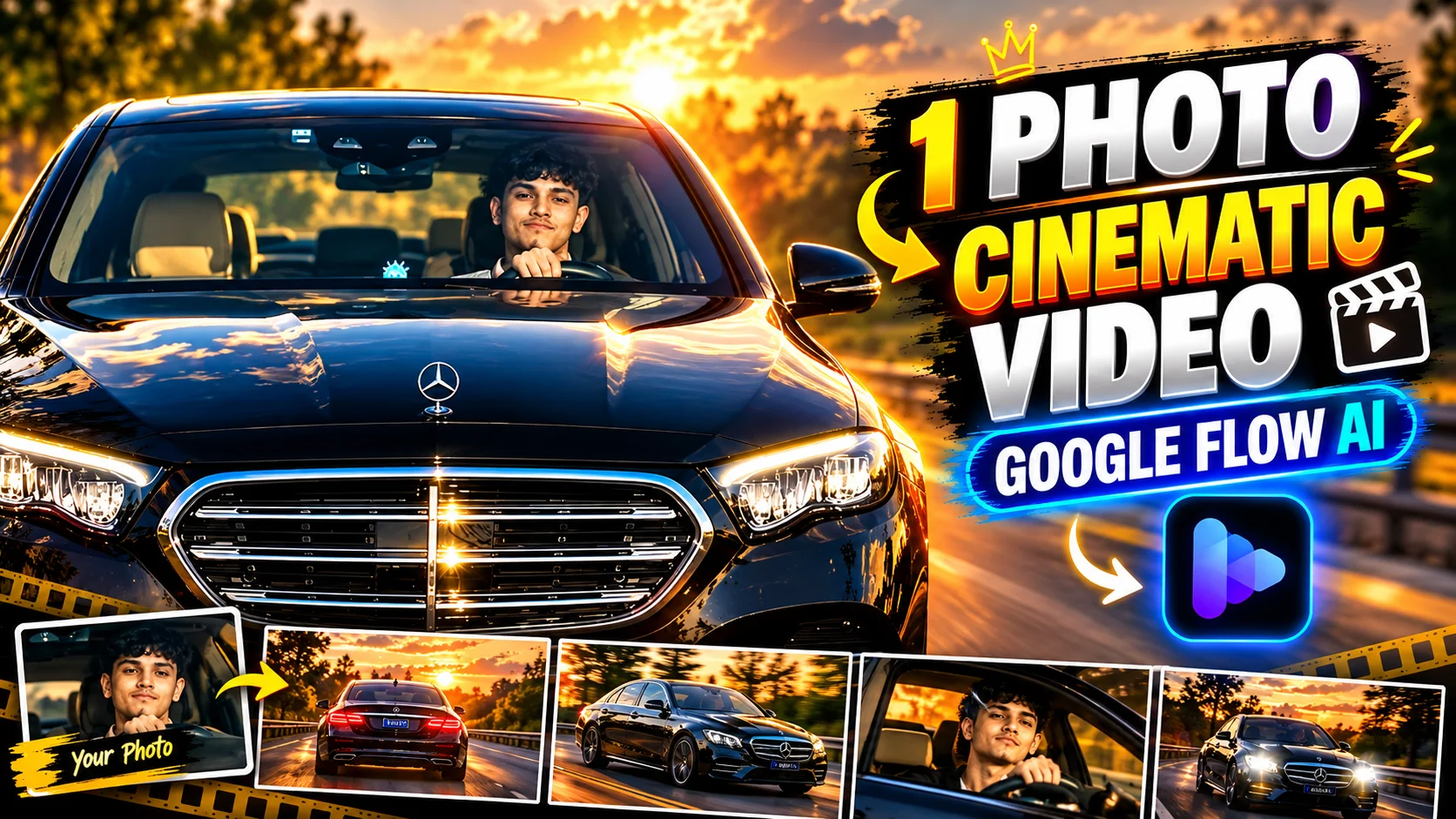
A single photograph can now serve as the starting point for a much more dynamic visual. Instead of keeping the subject in a static portrait, an image-to-video workflow can place them inside a luxury car scene with camera movement, facial motion, reflections, and changing perspective.
This style works especially well with a black Mercedes-Benz because the grille, metallic paint, windshield reflections, interior materials, and vehicle movement provide plenty of visual detail for a cinematic sequence.
The most convincing results, however, depend on realism rather than excessive effects. Natural skin, believable hand movement, physical car motion, proper reflections, subtle camera optics, and stable facial identity are more important than making every frame look artificially perfect.
The source workflow uses Google Flow and emphasizes starting with a clear reference image so the person’s appearance can remain recognizable during the generated sequence. Pasted text
What Makes a Cinematic Mercedes AI Video Look Realistic?
A convincing car video should look like footage recorded by a physical camera rather than a glossy 3D animation.
That means the vehicle should respond naturally to the environment. Metallic paint should reflect its surroundings, glass should show believable reflections and transparency, and the apparent size of the vehicle should change because the car physically moves toward the camera—not because of an artificial digital zoom.
Human details matter just as much. Facial identity should remain stable, skin should retain natural texture, eyes should blink normally, hair should move believably, and hands should follow realistic anatomy.
Camera movement should also follow the intended scene. If a reference video is being used, reproducing its framing, timing, perspective, movement, and scene transition is more useful than inventing additional camera moves.
Mercedes Car Video Prompts
Prompt 1: Real-World Mercedes Video Using a Reference Video
This version is designed for two uploaded references. The reference video controls the vehicle, motion, camera work, scene timing, lighting, actions, and composition, while the character image establishes the person’s identity.
Create an ultra-realistic REAL-WORLD CAMERA VIDEO that looks like genuine footage rather than an AI-generated, CGI, game-engine, or 3D-rendered scene.
Use TWO uploaded references:
REFERENCE VIDEO: Use this as the exact guide for the car, vehicle movement, camera position, camera movement, camera angle, framing, timing, scene transition, environment, lighting, actions, and overall visual composition.
CHARACTER IMAGE: Use this as the exact identity and appearance reference for the person.
The finished result must look like an actual camera recording of a real person physically sitting inside a real Mercedes-Benz.
REAL CAMERA APPEARANCE:
Use physically believable camera optics and natural real-world photographic characteristics. Maintain natural exposure, realistic dynamic range, smooth highlight roll-off, realistic motion blur, believable shutter motion, natural depth of field, subtle lens distortion, realistic focus transitions, very light sensor noise/grain, natural micro-contrast, realistic reflections, natural shadows, and believable ambient light.
Do not make the footage excessively sharp, glossy, oversaturated, HDR-heavy, digitally perfect, or artificially cinematic. Preserve the small optical imperfections expected from genuine camera footage.
REAL HUMAN:
Keep the uploaded person’s exact identity stable throughout the video. Preserve the same face shape, eyes, eyebrows, nose, lips, jawline, skin tone, hairstyle, facial hair, age, and natural facial proportions.
Retain visible skin pores, small natural imperfections, facial asymmetry, and realistic skin texture. Do not smooth or beautify the skin. Do not reshape the jaw, enlarge the eyes, change the nose, modify the lips, artificially symmetrize the face, or make the person look like an AI-generated model.
The person’s face must remain consistent throughout the entire sequence with no identity drift or facial warping.
EYES AND FACIAL MOVEMENT:
Make the eyes physically realistic with natural wetness, reflections, and blinking. Facial expressions should come from subtle, believable facial-muscle movement. Avoid frozen expressions, rubber-like facial movement, face distortion, or unnatural expression changes.
HAIR:
Render individual hair strands naturally. Hair should respond realistically to head movement and airflow without appearing painted, plastic, or artificially fixed.
HANDS:
Keep both hands anatomically correct with five fingers on each hand, realistic joints, fingernails, natural skin texture, correct proportions, and believable wrist movement.
Do not create extra fingers, fused fingers, malformed palms, disappearing fingers, floating hands, or physically impossible movements.
REAL MERCEDES-BENZ:
The black Mercedes-Benz must look like a photographed physical vehicle rather than a smooth CGI model.
Preserve realistic metallic black paint, clear-coat reflections, chrome grille, Mercedes emblem, LED headlights, windshield glass, side mirrors, body panels, panel gaps, rubber seals, tires, dashboard, steering wheel, leather seats, and realistic interior materials.
The paint must reflect the surrounding real environment naturally. Avoid impossible reflections or digitally perfect bodywork.
The windshield must behave like real glass with believable transparency, reflections, subtle tint, refraction, natural highlights, and glare.
CAR MOVEMENT:
Reproduce the vehicle movement shown in the reference video.
When the Mercedes approaches the camera, its apparent size must increase through REAL PHYSICAL MOVEMENT through space rather than artificial digital zoom.
The grille, headlights, hood, windshield, and driver should naturally become larger in the frame as distance decreases. Perspective must change correctly according to the changing distance between the camera and vehicle.
Maintain realistic wheel and body motion. Do not make the vehicle slide, float, or move like a 3D animation.
CAMERA:
Match the reference video’s camera behavior as closely as possible.
Reproduce the camera height, distance, lens perspective, field of view, framing, movement, speed, acceleration and deceleration, focus behavior, motion blur, and timing.
The camera should behave like a genuine handheld or mounted physical camera in the environment.
Do not invent additional camera movements. Do not use digital zoom as a substitute for physical movement. Do not orbit around the vehicle unless the reference video does. Do not introduce drone-like movement unless it exists in the reference.
SCENE 1 — EXTERIOR:
Recreate the opening exterior shot according to the reference video.
Show the real black Mercedes approaching the camera while preserving the same front-facing composition and camera position.
As the vehicle moves closer, naturally reveal increasing detail in the grille, Mercedes emblem, headlights, hood, windshield, and driver.
The driver must remain physically positioned inside the vehicle. Windshield reflections should naturally interact with the driver’s face without completely hiding it.
Preserve natural daylight and realistic environmental reflections.
SCENE 2 — TRANSITION:
At the same moment shown in the reference video, reproduce the transition or cut from the exterior shot to the interior shot.
Do not invent a different transition.
SCENE 3 — INTERIOR:
Reproduce the reference video’s interior composition.
Place the uploaded person naturally in the driver’s seat. Keep the real steering wheel visible in the foreground and show believable dashboard materials with a beige/cream leather interior.
Have the person look naturally toward the side and then toward the front/camera according to the reference video.
Keep one hand naturally positioned on or around the steering wheel whenever appropriate.
SCENE 4 — HUMAN MOVEMENT:
Reproduce the hand gesture, head movement, eye movement, and smile from the reference video.
Keep all movement subtle and physically realistic, including natural blinking, breathing, shoulder movement, head rotation, and facial-muscle movement.
SCENE 5 — FINAL EXPRESSION:
Match the final head position and expression from the reference.
The person should finish with a subtle, natural smile without exaggeration. Preserve the same identity and realistic skin texture.
LIGHTING:
Match the lighting visible in the reference video using physically believable daylight.
Light must interact naturally with the person’s skin and hair as well as the windshield glass, metal bodywork, black paint, chrome, dashboard, steering wheel, and leather interior.
Keep shadow direction and softness realistic.
Do not introduce artificial studio lighting, exaggerated cinematic glow, fake rim lighting, or neon illumination unless those elements already exist in the reference.
COLOR:
Use natural real-camera color science with realistic skin tones, believable black vehicle paint, a natural beige interior, and balanced highlights and shadows.
Avoid excessive saturation, excessive contrast, HDR appearance, and artificially perfect digital color.
Prompt 2: 10-Second Mercedes Night Video from One Photo
The second concept changes the setup significantly. It uses the uploaded person as the identity reference and places a young man inside a black luxury Mercedes at night, with a fixed steering-wheel foreground, cool interior light, and a specific body-motion sequence. Pasted text
Create a highly realistic 10-second cinematic video using the uploaded reference image/person as the exact identity reference.
IMPORTANT:
Preserve the person’s exact face, facial structure, skin tone, hairstyle, body proportions, outfit, and overall appearance throughout the entire video.
Do not change the person’s identity.
Use realistic human body-motion tracking, natural facial movement, and strong temporal consistency from frame to frame.
CAMERA AND SCENE:
Place a young man naturally in the driver’s seat of a black luxury Mercedes sedan at night.
Position the camera outside and toward the front of the car so that it gradually feels closer to the person through the windshield.
Keep the interior dimly illuminated with soft, cool nighttime lighting.
The steering wheel must remain visible in the foreground.
Include realistic windshield reflections, subtle dashboard illumination, natural shadows, and a cinematic DSLR-style appearance.
Avoid camera shake, unnatural warping, and unstable geometry.
BODY-MOTION TRACKING — FOLLOW THIS SEQUENCE:
0.0–1.2 SECONDS:
The person sits naturally behind the steering wheel with his upper body relaxed and centered.
Keep both shoulders stable.
He looks toward the camera with a calm expression.
Add only very subtle breathing movement through the chest and shoulders.
Use natural blinking.
Keep the hands in a believable driving position.
1.2–2.5 SECONDS:
He begins moving his upper body slightly toward the camera.
His head should move naturally together with the torso as he begins to smile.
One hand gradually lifts away from the steering wheel.
Track the movement naturally from shoulder to elbow, wrist, and fingers using correct human joint motion.
Do not create floating, disconnected, or anatomically incorrect fingers.
2.5–3.8 SECONDS:
He raises one hand beside his face and makes a casual two- or three-finger gesture.
The elbow bends naturally, the wrist rotates slightly, and the fingers move independently and realistically.
At the same time, he tilts his head slightly to one side.
Keep his eyes directed toward the camera.
His expression becomes playful and confident.
3.8–5.2 SECONDS:
He lowers the raised hand slightly while his smile becomes wider.
Show natural cheek movement with a subtle eye squint.
His head moves partially back toward the center.
The shoulders and neck should naturally follow the head movement.
Keep the steering wheel and surrounding Mercedes interior visually stable during the movement.
How to Create the Cinematic Mercedes Car Video in Google Flow
Start with a clear reference photograph. A sharp image where the subject’s face and overall appearance are easy to see gives the video generator more useful identity information.
Open Google Flow and sign in, then create a new project. Upload the reference image you want to animate.
For the single-image workflow, choose the available Frame to Video option and use the uploaded image as the starting frame. The supplied workflow specifies a 10-second video with a 16:9 aspect ratio. Pasted text
Copy the appropriate prompt from above and paste it into the video prompt field. Then start the generation.
After the clip is ready, watch the entire sequence rather than judging only the opening frame. Check the person’s identity, facial stability, hands, car interior, camera movement, lighting, reflections, and overall temporal consistency. The source specifically recommends generating another version when the initial result contains inconsistencies. Pasted text
Which Prompt Should You Use?
Use Prompt 1 when you already have a reference video whose movement and composition you want to reproduce. That workflow depends on both the video reference and a separate character image.
Use Prompt 2 when your starting point is a single person image and you want a short nighttime Mercedes driver scene with controlled facial and upper-body movement.
These are different workflows, so the correct prompt depends on the reference material you have available.
Tips for More Realistic AI Car Videos
Choose a high-quality reference photograph with a clearly visible face. Identity consistency becomes more difficult when the starting image is blurry, dark, or heavily processed.
Keep human movement restrained. Small head movements, natural blinking, subtle breathing, and controlled gestures generally fit this type of realistic footage better than exaggerated motion.
Lighting also needs to feel unified. The person, glass, dashboard, interior materials, and vehicle should appear to exist under the same lighting conditions.
For car scenes, pay close attention to reflections. Windshield glare and body reflections should interact naturally with the environment instead of appearing painted onto the vehicle.
When something is wrong, modify the specific problem rather than rewriting every part of the prompt. The source recommends making small changes between generations to identify which adjustment actually improves the result. Pasted text
Common Mistakes to Avoid
Using an Unclear Reference Image
A blurry or low-quality source photo gives the model less information about facial structure, hair, clothing, and proportions.
Expecting Perfect Results on the First Attempt
Video generation involves many consecutive frames, so problems with hands, expressions, backgrounds, or identity can become visible during motion even when the first frame looks good.
Creating Too Much Movement
Large or abrupt body movements make facial and anatomical consistency more difficult. Subtle gestures are better suited to this concept.
Using Artificial Vehicle Motion
If the Mercedes approaches the camera, its size and perspective should change because it moves physically through the scene. A digital zoom is not an equivalent substitute.
Making Everything Too Perfect
Extremely sharp skin, glossy materials, exaggerated HDR, unrealistic reflections, and excessive cinematic glow can make the scene look more synthetic rather than more realistic.
Checking Only a Single Frame
A convincing AI video requires consistency over time. Review the entire clip for changes in the face, fingers, steering wheel, dashboard, glass, vehicle geometry, and lighting.
Frequently Asked Questions
Can I create a Mercedes AI video from one photo?
Yes. The single-image workflow in the source uses a photograph as the starting reference and generates movement around that identity. Pasted text
Do I need professional video-editing skills?
No. The described workflow focuses primarily on selecting a suitable reference image and supplying clear instructions to the video-generation tool.
What kind of reference photo should I use?
Use a sharp, well-lit photograph with a clearly visible face and natural proportions. Extremely dark, blurry, or heavily edited images are weaker starting references.
Why can an AI-generated car video look unrealistic?
Inconsistencies can appear in hands, facial details, movement, vehicle geometry, or background elements. Reference-image quality and prompt clarity can both affect the result.
Can I use another car instead of a Mercedes?
Yes. The source indicates that the basic concept can be adapted to other vehicles, locations, and cinematic styles.
Conclusion
A strong cinematic car video depends less on excessive effects and more on consistency.
The face should remain recognizable, body motion should follow realistic joints, the Mercedes should behave like a physical vehicle, and camera movement should obey real perspective. Glass, chrome, paint, leather, shadows, and reflections should all respond naturally to the environment.
Google Flow provides the image-to-video workflow described in the supplied material, but the quality of the finished clip still depends heavily on the starting reference, prompt clarity, movement, and scene consistency. Pasted text
Using the more detailed two-reference prompt can help when you need to match an existing video’s cinematography, while the single-image prompt provides a simpler route for creating a controlled Mercedes driver scene from one portrait.